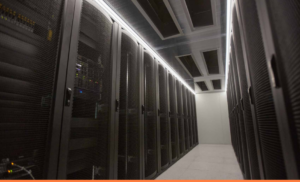

The exponential growth of digital information has turned data centers into essential infrastructure for the global economy. However, they account for nearly 3% of worldwide electricity consumption, raising concerns about environmental sustainability and operational efficiency.
Key factors driving high energy consumption
Hardware density: powerful, compact servers increase energy demand per m².
Cooling systems: critical for stability but responsible for up to 37% of total energy use.
Redundancy: necessary for reliability but adds significant energy overhead.
Main subsystems and efficiency metrics
Energy use in data centers is distributed across IT infrastructure (52%), cooling, UPS, lighting, electrical distribution, and auxiliary systems. Efficiency is measured using:
PUE (Power Usage Effectiveness): ratio of total energy to IT energy (ideal = 1.0).
DCiE: inverse of PUE, showing IT energy share.
CUE (Carbon Usage Effectiveness): measures CO₂ emissions.
WUE (Water Usage Effectiveness): measures water consumption.
Strategies to improve efficiency
IT Infrastructure:
Server virtualization.
Replacement of outdated equipment with efficient models.
Cooling systems:
Hot/Cold aisle containment.
Use of EC fans, variable-capacity compressors, and CFD airflow simulations.
Power systems (UPS):
Modular design with optimal redundancy.
Smart Sleep mode for partial load efficiency.
Batteries:
Adoption of Lithium-Ion for higher energy density, longer lifespan, and smarter management (BMS).
Monitoring and management:
CMMSedge IoT for real-time monitoring, alarms, historical data, and predictive maintenance.
Conclusion
By integrating advanced technologies and efficiency strategies, data centers can significantly lower operating costs and carbon footprint while improving sustainability. With over 15 years of expertise, Atlantic Power Energy provides state-of-the-art solutions in UPS, batteries, cooling, and monitoring, positioning itself as a leader in reliable and efficient critical infrastructure.